
- Каталог оборудования Siemens
- Каталог продуктов Siemens Industry
- Приводная техника
- Преобразователи
- Стандартные преобразователи
- Общая информация о базовых преобразователях SINAMICS V
- Преобразователи частоты общего назначения SINAMICS G
- Высокопроизводительные преобразователи SINAMICS S
- Сервопреобразователь SINAMICS S110
- SINAMICS S120
- SINAMICS S120M distributed servo drive
- SINAMICS S120 Combi
- SINAMICS S120 Chassis Format Units
- SINAMICS S120 Cabinet Modules
- Air-cooled unitsLine Connection ModulesBasic Line ModulesSmart Line ModulesActive Line Modules including Active Interface ModulesMotor Modules Booksize formatMotor Modules Chassis formatCentral Braking ModulesAuxiliary Power Supply ModulesCustomer terminal block -X55
- Air-cooled units
- Liquid-cooled units
- Options
- Supplementary system components
- Order-specific integration engineering
- Customized solutions
- SINAMICS S150 converter cabinet units
- MICROMASTER
- SIPLUS POSMO A
- SIMODRIVE POSMO
- LOHER DYNAVERT Drive System
- Преобразователи на среднее напряжение
- Преобразователи постоянного тока
- Стандартные преобразователи
- Двигатели переменного тока
- Generators
- Мотор-редукторы
- Flender Gear Units
- Couplings
- Инструментальное программное обеспечение
- Дополнительные компоненты
- Преобразователи
- Техника автоматизации
- Energy
- Автоматизация и безопасность зданий
- Низковольтная коммутационная техника
- Технология безопасности
- Системные решения и продукты для отраслей
- Сервис
- Приводная техника

Air-cooled units
- Информационные материалы
Информационные материалы
Line Modules
Power is fed to the drive line-up via Line Modules, which generate a DC voltage from the line voltage and, therefore, supply energy to the Motor Modules connected to the DC link. They are suitable for connection to grounded TN/TT and non-grounded IT systems.
The Line Modules are connected to the line supply system via Line Connection Modules and are equipped as standard according to Category C3. Category C3 is part of the "second environment" (in accordance with EN 61800-3). The “second environment” constitutes locations outside residential areas or industrial sites which are supplied from the medium-voltage network via a separate transformer.
The range of Line Modules has power ratings from 132 kW to 900 kW (380 V to 480 V) and from 250 kW to 1500 kW (500 V to 690 V). Furthermore, up to four identical Line Modules can be connected in parallel in order to increase the power rating.
For a compact configuration, Line Connection Modules up to input currents of 3200 A are available. Two Line Modules can be operated in parallel on these Line Connection Modules.
The following types of Line Module are available:
- Basic Line Modules
- Smart Line Modules
- Active Line Modules
Basic Line Modules
Basic Line Modules are designed only for infeed operation, i.e. they are not capable of recovering energy to the line supply.
If regenerative energy is produced, e.g. when the drives brake, then it must be converted to heat by means of a Braking Module and a braking resistor.
When a Basic Line Module is used as the infeed, a line reactor appropriate to the supply conditions must be installed. Line reactors are generally required if two or more Basic Line Modules are operated in parallel on a common supply system in order to increase power.
For this reason, line reactors are installed in the appropriate Line Connection Module as standard.
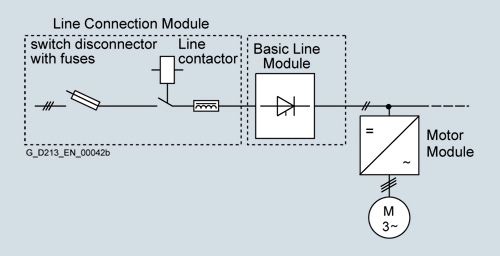
Line Connection Module with Basic Line Module ≤800 A
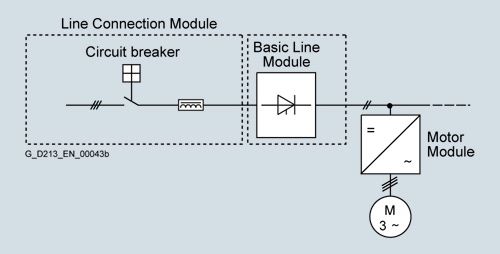
Line Connection Module with Basic Line Module >800 A
If, for example, a converter transformer is used to connect to the line supply (12-pulse operation), it may be possible to omit line reactors (depending on the supply conditions on site) and they can be optionally deselected (option L22 for a Line Connection Module combined with a Basic Line Module).
For a compact configuration, Line Connection Modules with input currents of up to 3200 A are available. Two Basic Line Modules can be operated in parallel on these Line Connection Modules. Versions with line-side fuses are available for parallel connections in order to provide selective protection of the individual Basic Line Modules.
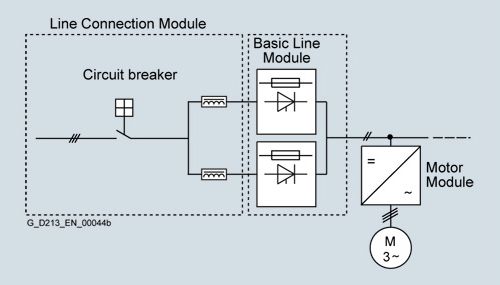
Line Connection Module with Basic Line Modules connected in parallel
Smart Line Modules
Smart Line Modules can supply energy to the DC link and return regenerative energy to the supply system. Braking Modules and braking resistors are required only if the drives need to be decelerated in a controlled manner after a power failure (i.e. when energy cannot be recovered to the supply). When a Smart Line Module is used as the infeed, the necessary line reactor is included in the device as standard and can be optionally deselected (option L22).
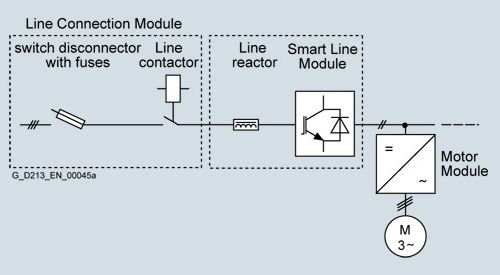
Line Connection Module with Smart Line Module ≤800 A
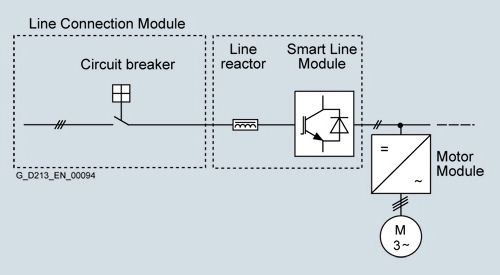
Line Connection Module with Smart Line Module >800 A
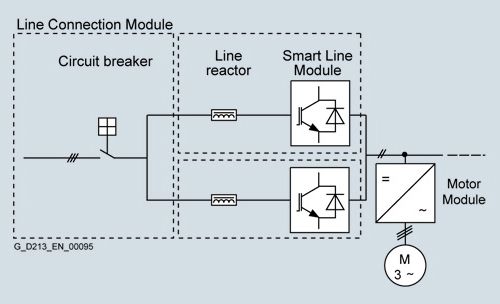
Line Connection Module with Smart Line Modules connected in parallel
Active Line Modules
Active Line Modules can supply energy to the DC link and return regenerative energy to the supply system. Braking Modules and braking resistors are required only if the drives need to be decelerated in a controlled manner after a power failure (i.e. when energy cannot be recovered to the supply).
In contrast to Basic Line Modules and Smart Line Modules, however, Active Line Modules generate a regulated DC voltage which remains constant despite fluctuations in the line voltage. However, in this case, the line voltage must remain within the permissible tolerance range. Active Line Modules draw a virtually sinusoidal current from the supply which limits any harmful harmonics.
Active Line Modules must always be used in conjunction with an Active Interface Module. Active Interface Modules include the required pre-charging circuit for the Active Line Module in addition to a Clean Power Filter. For SINAMICS S120 Cabinet Modules, these two components are always regarded as a single unit.
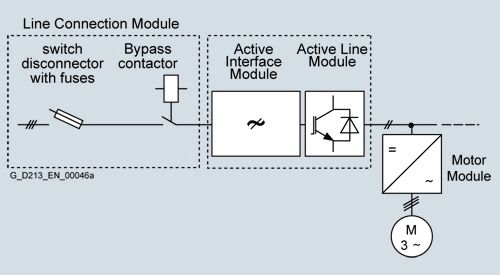
Line Connection Module with Active Interface Module and Active Line Module ≤ 800 A (example frame size HX + HI)
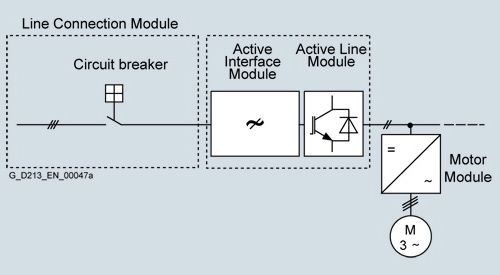
Line Connection Module with Active Interface Module and Active Line Module >800 A
In the example, two units comprising an Active Interface Module and Active Line Module are connected in parallel to jointly supply the DC link.
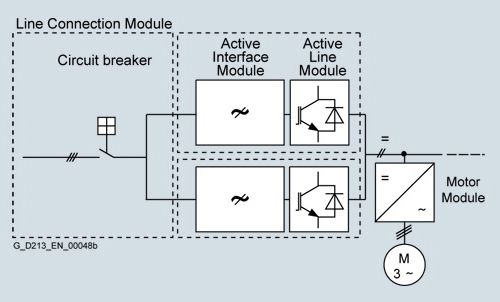
Line Connection Module with Active Interface Modules and Active Line Modules connected in parallel
DC link components
Braking Modules enable braking resistors to absorb the regenerative energy produced during drive deceleration, which is then converted into heat. Using a Braking Module and a braking resistor, it is possible to brake motors even when the power fails.
Braking Modules as a Line Module or Motor Module option
For lower braking powers, Braking Modules are available with continuous braking powers up to 50 kW. These Braking Modules are ordered as an option for the Line Modules and Motor Modules (order codes L61/L64 (25 kW) or L62/L65 (50 kW), refer to the option description).
Central Braking Modules
For higher continuous braking powers, separate Central Braking Modules are available. These modules are used centrally in the drive line-up. To increase the braking power, up to four Central Braking Modules can be connected in parallel.
Motor Modules
There are two different types of Motor Module available with the SINAMICS S120 Cabinet Modules drive system.
Booksize Base Cabinets with Booksize Cabinet Kits
Motor Modules at the low end of the power range from 4.8 kW to 71 kW (380 V to 480 V) can be implemented as Booksize Cabinet Kits installed in Booksize Base Cabinets.
Chassis Cabinets
Each Chassis Cabinet is fitted with one SINAMICS S120 Motor Module in chassis format and covers the power range from 75 kW to 1200 kW (380 V to 480 V or 500 V to 690 V). The power rating can be extended up to approx. 4500 kW by connecting up to four Motor Modules in the chassis format in parallel.
SINAMICS S120 Motor Modules in chassis format can also be used as a Braking Module (braking chopper) if a 3-phase braking resistor is connected instead of a motor.
For more information on this topic, please refer to the SINAMICS Low Voltage Engineering Manual.Auxiliary Power Supply Modules
Auxiliary Power Supply Modules supply power to the auxiliary power supply system of the SINAMICS S120 Cabinet Modules.
Units connected to this auxiliary power supply system include the fans of the SINAMICS S120 devices installed in the Cabinet Modules. In addition, the auxiliary power supply system supplies the electronic modules with an external 24 V DC voltage. This is required when the DC link is not charged, for instance, in order to maintain PROFIBUS or PROFINET communication.
Характеристика
Derating data for the chassis format
SINAMICS S120 Cabinet Modules and the associated system components are rated for an ambient temperature of 40 °C and installation altitudes up to 2000 m above sea level.
At ambient temperatures > 40 °C, the output current must be reduced. Ambient temperatures above 50 °C are not permissible.
At installation altitudes > 2000 m above sea level, it must be taken into account that the air pressure, and therefore air density, decreases as the height increases. As a consequence, the cooling efficiency and the insulation capacity of the air also decrease.
Due to the reduced cooling efficiency, it is necessary to both reduce the ambient temperature and lower heat loss in the Cabinet Module by reducing the output current, whereby ambient temperatures lower than 40 °C may be offset to compensate.
The following table specifies the permissible output currents as a function of the installation altitude and ambient temperature for the various degrees of protection. (The permissible compensation between installation altitude and the ambient temperatures < 40 °C – air intake temperature at the entry to the Cabinet Module – has been taken into account in the specified values.)
The values apply under the precondition that it is guaranteed that the cooling air, as specified in the technical data, flows through the units as a result of the cabinet arrangement.
As additional measure for installation altitudes from 2000 m up to 5000 m, an isolating transformer is required in order to reduce transient overvoltages according to EN 60664‑1.
For additional information, please refer to the SINAMICS Low Voltage Engineering Manual.Current-derating factors for Cabinet Modules as a function of the ambient/air intake temperature, the installation altitude and the degree of protection.
Degree of protection
Installation altitude above sea level
Current derating factor (as a percentage of the rated current)
for an ambient / air intake temperature ofm
20 °C
25 °C
30 °C
35 °C
40 °C
45 °C
50 °C
IP20, IP21, IP23, IP43
0 ... 2000
100 %
100 %
100 %
100 %
100 %
93.3 %
86.7 %
2001 ... 2500
100 %
100 %
100 %
100 %
96.3 %
2501 ... 3000
100 %
100 %
100 %
98.7 %
3001 ... 3500
100 %
100 %
100 %
3501 ... 4000
100 %
100 %
96.3 %
4001 ... 4500
100 %
97.5 %
4501 ... 5000
98.2 %
IP54
0 ... 2000
100 %
100 %
100 %
100 %
93.3 %
86.7 %
80 %
2001 ... 2500
100 %
100 %
100 %
96.3 %
89.8 %
2501 ... 3000
100 %
100 %
98.7 %
92.5 %
3001 ... 3500
100 %
100 %
94.7 %
3501 ... 4000
100 %
96.3 %
90.7 %
4001 ... 4500
97.5 %
92.1 %
4501 ... 5000
93 %
Current derating for SINAMICS S120 Motor Modules, chassis format as a function of the pulse frequency
To reduce motor noise or to increase output frequency, the pulse frequency can be increased relative to the factory setting (1.25 kHz or 2 kHz). When the pulse frequency is increased, the derating factor of the output current must be taken into account. This derating factor must be applied to the currents specified in the technical specifications.
Further information is provided in the SINAMICS Low Voltage Engineering Manual.Derating factor of the output current as a function of the pulse frequency for units with a rated pulse frequency of 2 kHz
Motor Module in chassis format
Type rating
at 400 VOutput current
at 2 kHzDerating factor
at pulse frequency
6SL3720-...
kW
A
2.5 kHz
4 kHz
5 kHz
7.5 kHz
8 kHz
380 ... 480 V 3 AC
1TE32-1AA3
110
210
95 %
82 %
74 %
54 %
50 %
1TE32-6AA3
132
260
95 %
83 %
74 %
54 %
50 %
1TE33-1AA3
160
310
97 %
88 %
78 %
54 %
50 %
1TE33-8AA3
200
380
96 %
87 %
77 %
54 %
50 %
1TE35-0AA3
250
490
94 %
78 %
71 %
53 %
50 %
Derating factor of the output current as a function of the pulse frequency for units with a rated pulse frequency of 1.25 kHz
Motor Module in chassis format
Type rating
at 400 V or 690 VOutput current
at 1.25 kHzDerating factor
at pulse frequency
6SL3720-...
kW
A
2 kHz
2.5 kHz
4 kHz
5 kHz
7.5 kHz
380 ... 480 V 3 AC
1TE36-1AA3
315
605
83 %
72 %
64 %
60 %
40 %
1TE37-5AA3
400
745
83 %
72 %
64 %
60 %
40 %
1TE38-4AA3
450
840
87 %
79 %
64 %
55 %
40 %
1TE41-0AA3
560
985
92 %
87 %
70 %
60 %
50 %
1TE41-2AA3
710
1260
92 %
87 %
70 %
60 %
50 %
1TE41-4AA3
800
1405
97 %
95 %
74 %
60 %
50 %
500 ... 690 V 3 AC
1TG28-5AA3
75
85
93 %
89 %
71 %
60 %
40 %
1TG31-0AA3
90
100
92 %
88 %
71 %
60 %
40 %
1TG31-2AA3
110
120
92 %
88 %
71 %
60 %
40 %
1TG31-5AA3
132
150
90 %
84 %
66 %
55 %
35 %
1TG31-8AA3
160
175
92 %
87 %
70 %
60 %
40 %
1TG32-2AA3
200
215
92 %
87 %
70 %
60 %
40 %
1TG32-6AA3
250
260
92 %
88 %
71 %
60 %
40 %
1TG33-3AA3
315
330
89 %
82 %
65 %
55 %
40 %
1TG34-1AA3
400
410
89 %
82 %
65 %
55 %
35 %
1TG34-7AA3
450
465
92 %
87 %
67 %
55 %
35 %
1TG35-8AA3
560
575
91 %
85 %
64 %
50 %
35 %
1TG37-4AA3
710
735
87 %
79 %
64 %
55 %
25 %
1TG38-1AA3
800
810
97 %
95 %
71 %
55 %
35 %
1TG38-8AA3
900
910
92 %
87 %
67 %
55 %
33 %
1TG41-0AA3
1000
1025
91 %
86 %
64 %
50 %
30 %
1TG41-3AA3
1200
1270
87 %
79 %
55 %
40 %
25 %
The following tables list the maximum achievable output frequency as a function of the pulse frequency:
Maximum output frequencies achieved by increasing the pulse frequency in Vector mode
Pulse frequency
Max. achievable output frequency
1.25 kHz
100 Hz
2 kHz
160 Hz
2.5 kHz
200 Hz
4 kHz
300 Hz
Maximum output frequencies achieved by increasing the pulse frequency in Servo mode
Pulse frequency
Max. achievable output frequency
2 kHz
300 Hz
4 kHz
300/550 Hz 1)
1) Higher frequencies on request.
Derating data for devices in booksize format
SINAMICS S120 Cabinet Modules with power units in booksize format and the associated system components are rated for an ambient temperature of 40 °C and installation altitudes up to 1000 m above sea level. If SINAMICS S120 Cabinet Modules with power units in booksize format are operated at ambient temperatures higher than 40 °C and/or installation altitudes higher than 1000 m above sea level, then the corresponding derating functions must be taken into account as a function of the ambient temperature and/or the installation altitude. These derating factors are different from the derating factors for the chassis format power units and are listed in Catalog PM 21.
Overload capability
SINAMICS S120 Cabinet Modules have an overload reserve, e.g. to handle breakaway torques. If larger surge loads occur, this must be taken into account when configuring. For drives with overload requirements, the appropriate base load current must, therefore, be used as a basis for the required load.
Permissible overload assumes that the drive converter is operated at its base-load current before and after the overload occurs, based on a duty cycle duration of 300 s.
For temporary, periodic duty cycles with high variations of load within the duty cycle, the relevant sections of the SINAMICS Low Voltage Engineering Manual must be observed.
Motor Modules in chassis format
Motor Modules with power units in the chassis format can be configured on the basis of different base load currents.
The base-load current for a low overload IL is the basis for a duty cycle of 110 % for 60 s or 150 % for 10 s.
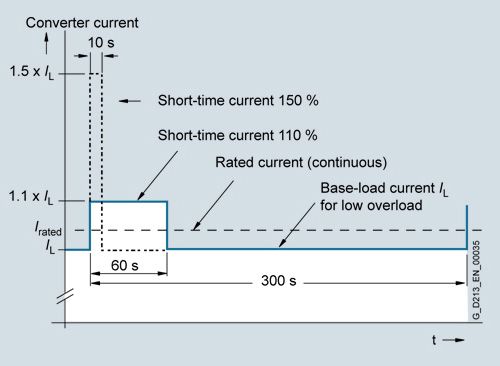
Low overload
The base-load current IH for a high overload is based on a load cycle of 150 % for 60 s or 160 % for 10 s.

High overload
Motor Modules in booksize format
Motor Modules with power units in the booksize format have the following overload capabilities:
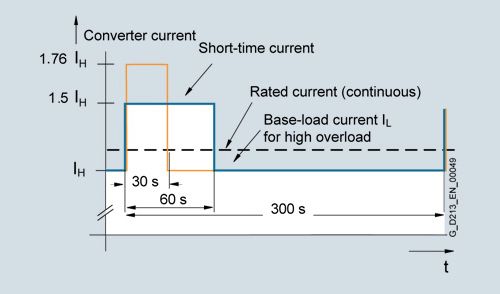
High overload
Line Modules in chassis format
The base-load current for a high overload IH DC is the basis for a duty cycle of 150 % for 60 s or Imax DC for 5 s.
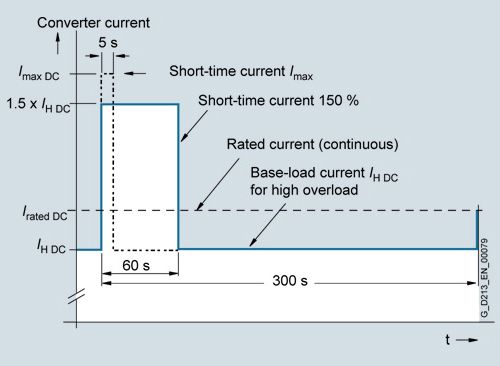
Технические данные
General technical specifications
Electrical specifications
Line voltages
380 ... 480 V 3 AC, ±10 % (-15 % <1 min)
500 … 690 V 3 AC, ±10 % (-15 % <1 min)
Line supply types
Grounded TN/TT systems and non-grounded IT systems
Line frequency
47 ... 63 Hz
Output frequency 1)
- Control type Servo
0 ... 550 Hz
- Control type Vector
0 ... 550 Hz
- Control mode V/f
0 ... 550 Hz
Line power factor
Fundamental- Basic Line Module
>0.96
- Smart Line Module
>0.96
- Active Line Module
Adjustable (factory-set to cos φ = 1)
Efficiency
- Basic Line Module
>99 %
- Smart Line Module
>98.5 %
- Active Line Module
>97.5 % (including Active Interface Module)
- Motor Module
>98.5 %
Overvoltage category
III to EN 61800‑5‑1
Control method
Vector/Servo control with and without encoder or V/f control
Fixed speeds
15 fixed speeds plus 1 minimum speed, parameterizable (in the default setting, 3 fixed setpoints plus 1 minimum speed are selectable using terminal block/PROFIBUS/PROFINET)
Skippable speed ranges
4, parameterizable
Setpoint resolution
0.001 rpm digital (14 bits + sign)
12 bits analogBraking operation
With Active Line Modules and Smart Line Modules, four-quadrant operation as standard (energy recovery).
With Basic Line Modules, two-quadrant operation as standard,
braking by means of an optional braking chopper, or alternatively by a Motor Module.Cabinet system
Cabinet system
Rittal TS 8, doors with double-bit key, three-section base plates for cable entry
Paint finish
RAL 7035 (indoor requirements)
Mechanical specifications
Degree of protection
IP20 (higher degrees of protection up to IP54 optional)
Protection class
I acc. to EN 61800‑5‑1
Touch protection
EN 50274/BGV A3 for the intended purpose
Cooling method
Forced air cooling AF according to EN 60146
Ambient conditions
Storage 2)
Transport 2)
Operation
Ambient temperature
-25 ... +55 °C
-25 ... +70 °C
from -40 °C for 24 hours0 ... +40 °C
to +50 °C see derating dataRelative humidity
(condensation not permissible)
5 ... 95 %
Class 1K4 to IEC 60721‑3‑15 ... 95 % at 40 °C
Class 2K3 acc. to IEC 60721‑3‑25 ... 95 %
Class 3K3 acc. to IEC 60721‑3‑3Environmental class/harmful chemical substances
Class 1C2
acc. to EN 60721‑3‑1Class 2C2
acc. to EN 60721‑3‑2Class 3C2
acc. to EN 60721‑3‑3Organic/biological influences
Class 1B1
acc. to EN 60721‑3‑1Class 2B1
acc. to EN 60721‑3‑2Class 3B1
acc. to EN 60721‑3‑3Degree of pollution
2 acc. to EN 61800‑5‑1
Installation altitude
Cabinet Modules chassis format:
≤2000 m above sea level - no derating; >2000 m, see characteristic curves/derating dataFor Booksize Cabinet Kit format Motor Modules as well as Central Braking Modules:
≤ 1000 m above sea level without derating, > 1000 m, see characteristic curves/derating dataMechanical stability
Storage 2)
Transport 2)
Operation
Vibration load
Class 1M2
acc. to EN 60721‑3‑1Class 2M2
acc. to EN 60721‑3‑2–
- Deflection
1.5 mm at 5 ... 9 Hz
3.1 mm at 5 ... 9 Hz
0.075 mm at 10 ... 58 Hz
- Acceleration
5 m/s² at >9 ... 200 Hz
10 m/s² at >9 ... 200 Hz
9.8 m/s² at >58 ... 200 Hz
Shock load
Class 1M2
acc. to EN 60721‑3‑1Class 2M2
acc. to EN 60721‑3‑2Class 3M4
acc. to EN 60721‑3‑3- Acceleration
40 m/s² at 22 ms
100 m/s² at 11 ms
100 m/s² at 11 ms
Compliance with standards
Conformances/approvals, according to
CE (EMC Directive No. 2004/108/EC and Low Voltage Directive No. 2006/95/EC and Machinery Directive 2006/42/EC for functional safety)
Radio interference suppression
SINAMICS drive converter systems are not designed for connection to the public grid (first environment). Radio interference suppression is compliant with the EMC product standard for variable-speed drives EN 61800‑3, "Second environment" (industrial networks). EMC disturbances can occur when connected to the public power networks. However, if additional measures are taken (e.g. → line filter), it can also be operated in the "first environment".
1) Higher output frequencies available on request.
2) In transport packaging.
Deviations from the specified class are underlined.