
- Каталог оборудования Siemens
- Каталог продуктов Siemens Industry
- Приводная техника
- Техника автоматизации
- Системы автоматизации
- Системы визуализации SIMATIC HMI
- Системы идентификации
- Промышленные коммуникации SIMATIC NET
- Промышленные аппараты управления SIRIUS
- Системы
- Коммутационные аппараты SIRIUS
- Аппаратура защиты
- Фидеры и пускатели двигателей
- Функциональные, коммутирующие реле и преобразователи
- Сиcтема обслуживания двигателей
- Логические модули LOGO!
- Реле контроля SIRIUS 3RR, 3UG для электрических и неэлектрических величин.
- Электронное реле времени
- Monitoring relays
- Реле контроля SIRIUS 3RR2 для установки на контакторы 3RT2
- Реле контроля тока SIRIUS 3RR24 с IO-Link
- Реле контроля электрических величин
- Реле контроля SIRIUS 3UG48 для отдельной установки (с возможностью коммуникации по IO-Link)
- Реле контроля температурыАналоговые регулируемые релеЦифровые регулируемые реле DIN 3440Цифровые регулируемые реле для 3 сенсоровАксессуары
- Реле контроля температуры
- Реле контроля температуры SIRIUS 3RS14, 3RS15 с возможностью коммуникации по IO-Link
- SIRIUS 3RN2 thermistor motor protection
- Для холодно-паянных температурных датчиков
- Термисторная защита двигателей
- Согласующие реле и преобразователи сигналов
- Оборудование безопасности
- Позиционные выключатели и выключатели для систем безопасности
- Устройства управления и индикации
- Планирование и конфигурирование для SIRIUS
- Блоки питания SITOP
- Блоки питания SIRIUS 4AV
- Transformers
- Фильтры SIDAC-F
- Дроссели SIDAC-D
- Промышленные информационные технологии
- Управление на базе РС
- Системы управления процессом
- Контрольно-измерительные приборы
- Анализаторы процесса
- Блоки питания SITOP
- Продукты для специальных требований
- Energy
- Автоматизация и безопасность зданий
- Низковольтная коммутационная техника
- Технология безопасности
- Системные решения и продукты для отраслей
- Сервис
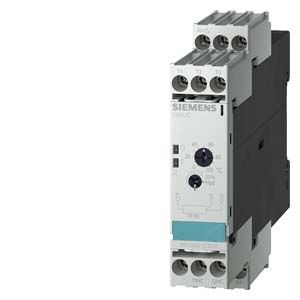
Реле контроля температуры
- Информационные материалы
Информационные материалы
Реле контроля температуры SIMIREL 3RS10/3RS11 могут применяться для измерения температуры в твердых, жидких и газообразных средах. Температура измеряется датчиком в среде и обрабатывается реле, которое контролирует превышение верхней или нижней границы рабочего диапазона, а также удерживает уставки в пределах заданного диапазона (функция окна). Семейство состоит из аналоговых регулируемых аппаратов с одним или двумя пороговыми значениями, цифровых аппаратов согласно DIN 3440, представляющих хорошую альтернативу регуляторам температуры в секторе экономичного оборудования, и цифровых аппаратов, имеющих до 3 датчиков, оптимизированных для контроля крупных двигателей.
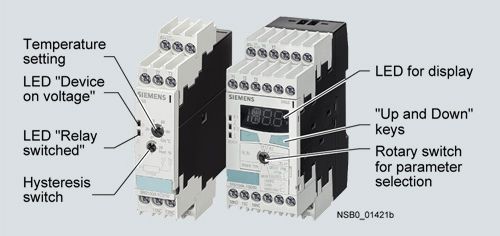
Особенности
Преимущества от энергоэффективности

Процесс энергоменеджмента
Новые промышленные аппараты SIRIUS могут внести основной вклад в энергоэффективность предприятия (http://webservices.siemens.com/medaps/webeditor/www.siemens.de/sirius/energiesparen).
Реле контроля температуры 3RS10, 3RS11, 3RS20 and 3RS21вносят следующий вклад:
- Контроль обогрева и вентиляции технологических процессов и пространства шкафов управления
Технические данные
More information
For technical specifications, see https://support.industry.siemens.com/cs/ww/en/ps/16369/td
For FAQs, see https://support.industry.siemens.com/cs/ww/en/ps/16369/faq
For the manual and circuit diagrams, see https://support.industry.siemens.com/cs/ww/en/view/54999309
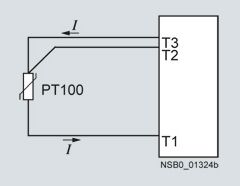
Connection of resistance-type thermometers
Two-wire measurement
When two-wire temperature sensors are used, the resistances of the sensor and wiring are added. The resulting systematic error must be taken into account when the signal evaluation unit is calibrated. A jumper must be connected between terminals T2 and T3 for this purpose.

Wiring errors
The errors that are generated by the wiring comprise approximately 2.5 K/Ω. If the resistance of the cable is not known and cannot be measured, the wiring errors can also be estimated using the following table.
Temperature drift dependent on the length and cross-section of the cable with PT100 sensors and an ambient temperature of 20 °C, in K:
Cable length in m
Cross-section mm²
0.5
0.75
1
1.5
Temperature drift in K:
0
0
0
0
0
10
1.8
1.2
0.9
0.6
25
4.5
3.0
2.3
1.5
50
9.0
6.0
4.5
3.0
75
13.6
9.0
6.8
4.5
100
18.1
12.1
9.0
6.0
200
36.3
24.2
18.1
12.1
500
91.6
60.8
45.5
30.2
Example: on a PT100 sensor with a cable length of 10 m and a conductor cross-section of 1 mm2 the temperature drift equals 0.9 K.
Three-wire measurement
To minimize the effects of the line resistances, a three-wire circuit is often used. Using the additional cable, two measuring circuits can be formed of which one is used as a reference. The signal evaluation unit can then automatically calculate the line resistance and take it into account.
Connection of thermocouples
Based on the thermo-electrical effect, a differential temperature measurement will be performed between the measuring point and the signal evaluation unit.
This principle assumes that the signal evaluation unit knows the temperature at the clamping point (T2). For this reason, the 3RS11 temperature monitoring relay has an integral compensator that determines this comparison temperature and builds it into the result of the measurement. The thermal sensors and cables must therefore be insulated.
The absolute temperature is therefore calculated from the ambient temperature of the signal evaluation unit and the temperature difference measured by the thermocouple. Temperature detection is therefore possible (T1) without needing to know the precise ambient temperature of the clamping point at the signal evaluation unit (T2).
The connecting cable is only permitted to be extended using connecting leads that are made from the same material as the thermocouple. If a different type of conductor is used, an error will result in the measurement.

For more information, see http://www.ephy-mess.de/en/welcome/
Operating principle
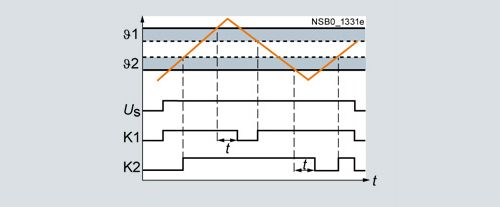
Once the temperature has reached the set threshold value ϑ1, the output relay K1 changes its switching state as soon as the set time t has elapsed (K2 responds in the same manner to ϑ2). The delay time can only be adjusted with digital units (t = 0 on analog units).
The relays return to their original state as soon as the temperature reaches the set hysteresis value.
Temperature overshoot
Closed-circuit principle

Temperature undershoot
Closed-circuit principle

Range monitoring (digital units only)
Once the temperature has reached the upper threshold value ϑ1, the output relay K1 changes its switching state as soon as the set time t has elapsed. The relay returns to its original state as soon as the temperature reaches the set hysteresis value.
K2 responds in the same manner to the lower threshold value of ϑ2.
Closed-circuit principle
Principle of operation with memory function (3RS1042, 3RS1142) based on the example of temperature overshoot
Once the temperature has reached the set threshold value ϑ1, the output relay K1 changes its switching state as soon as the set time t has elapsed (K2 responds analogously to ϑ2). The relays only return to the original state when the temperature falls below the set hysteresis value and when terminals Y3-Y4 have been briefly jumpered.
Closed-circuit principle

Characteristic curves
For resistance sensors

Short-circuit and open-circuit detection as well as the measuring range are limited, depending on the sensor type.
Measuring ranges in °C for resistance sensors
Sensor type
Short circuit
Open circuit
3RS1040/3RS1041
Measuring range in °C3RS1042
Measuring range in °CPT100
✓
✓
–50 ... +500
–50 ... +750
PT1000
✓
✓
–50 ... +500
–50 ... +500
KTY83-110
✓
✓
–50 ... +175
–50 ... +175
KTY84
✓
✓
–40 ... +300
–40 ... +300
NTC1)
✓
--
+80 ... +160
+80 ... +160
✓ Detection possible
-- Detection not possible1) NTC type: B57227-K333-A1 (100 °C: 1.8 kΩ; 25 °C: 32.762 kΩ).
For thermocouples

Characteristic curves for sensor types J, K, T, E, N

Characteristic curves for sensor types S, R and B
Measuring ranges in °C for thermocouples
Sensor type
Short circuit
Open circuit
3RS1040/3RS1041Measuring range in °C
3RS1042
Measuring range in °CJ
--
✓
–99 ... +999
–99 ... +1200
K
--
✓
–99 ... +999
–99 ... +1350
T
--
✓
–99 ... +400
–99 ... +400
E
--
✓
–99 ... +999
–99 ... +999
N
--
✓
–99 ... +999
–99 ... +999
S
--
✓
--
0 ... +1750
R
--
✓
--
0 ... +1750
B
--
✓
--
400 ... +1800
✓ Detection possible
-- Detection not possibleДальнейшая информация
Инструкция "3RS1/3RS2 Temperature Monitoring Relays"
http://support.automation.siemens.com/WW/view/en/54999309.