
- Каталог оборудования Siemens
- Каталог продуктов Siemens Industry
- Приводная техника
- Техника автоматизации
- Energy
- Автоматизация и безопасность зданий
- Низковольтная коммутационная техника
- Технология безопасности
- Технология безопасности для атвоматизации предприятия
- Приводы
- Встроенные функции безопасности
- Safety Integrated for SINAMICS G120C
- Safety Integrated for SINAMICS G120
- Safety Integrated for SINAMICS G110M
- Safety Integrated for SINAMICS G110D
- Safety Integrated for SINAMICS G120D
- Safety Integrated for SINAMICS S110
- Safety Integrated for SINAMICS S120 built-in units
- Safety Integrated for SINAMICS S120 built-in units
- Компактные преобразователи SINAMICS G120C
- Стандартные преобразователи SINAMICS G120
- SINAMICS G110M distributed inverters
- Преобразователь частоты SINAMICS G110D для распределенной периферии
- Преобразователи частоты SINAMICS G120D
- ET 200pro FC Frequency Converter
- Сервопреобразователь SINAMICS S110
- SINAMICS S120
- SINAMICS S120
- SINAMICS S120 шасси и модули шкафов
- Встроенные функции безопасности
- Промышленные системы автоматизации SIMATIC
- Коммуникации
- SIRIUS Safety Integrated
- Приводы
- Технология безопасности для автоматизации процессов
- Технология безопасности для атвоматизации предприятия
- Системные решения и продукты для отраслей
- Сервис

Safety Integrated for SINAMICS S120 built-in units
- Информационные материалы
Информационные материалы

The integrated safety functions of SINAMICS S120 provide highly effective application-oriented protection for personnel and machinery. They are suitable for machines and systems that require flexible safety functions and support the setup of tailored safety concepts.
SINAMICS S120 offers Extended Functions (SS1 with SBR/SAM, SS2, SOS, SLS, SDI, SSM, SLP, SP, SBT) in addition to Basic Functions (STO, SS1, SBC).
The SP function and the SBT diagnostic function go beyond the functional scope according to IEC 61800‑5‑2.
The Safety Integrated functions are fully integrated in the drive system. They can be activated as follows:
- Via safety-related inputs on the CU310‑2 Control Unit
- Via safety-related inputs on the TM54F Terminal Module
- Via PROFIBUS or PROFINET with the PROFIsafe profile
The Safety Integrated functions are implemented electronically and therefore offer short response times compared to solutions with externally implemented monitoring functions.
As an alternative to controlling via terminals and/or PROFIsafe, there is also the option to parameterize several safety functions without selection. In this mode, after parameterization and a POWER ON, these functions are permanently selected.
Example:
"SLS without selection" can be used, for example, to monitor the maximum velocity to prevent the drive from exceeding a mechanical speed limit. For this purpose, using the "without selection" function, an F‑DI does not have to be used; an F‑CPU is also not required.
Safe speed/position sensing
Incremental encoders or absolute encoders can be used for safe sensing of the position values on a drive. Safe actual value sensing relies on redundant evaluation of the incremental tracks A/B that supply sin/cos signals of 1 Vpp. Only encoders of the type whose A/B track signals are created and processed using purely analog techniques can be used. The encoder signals can be input via the Sensor Modules.
HTL/TTL encoders can be used in a 2-encoder system to achieve safe actual value sensing. The minimum possible speed resolution must also be taken into account. The encoder signals are input via the SMC30 Sensor Module.
As an alternative, motors with an integrated DRIVE-CLiQ interface can be used. The speed or position actual values are generated directly in the motor as safe values and are transferred to the Control Unit over safe communication via DRIVE-CLiQ.
The encoder must be mechanically attached in such a manner that the encoder shaft is unable to unplug or slide off. For notes on this, see IEC 61800‑5‑2: 2016, Table D.16.
A list of Siemens motors that fulfill the electrical and mechanical requirements is available at:
https://support.industry.siemens.com/cs/document/33512621
The following can be used for safe speed/position sensing:
- Single-encoder systems or
- 2-encoder systems
Single-encoder systems
In a single-encoder system, the motor encoder is used exclusively for safe actual value sensing.
2-encoder systems
The safe actual values for a drive are provided by two separate encoders. The actual values are transferred to the Control Unit over DRIVE-CLiQ. When motors without a DRIVE-CLiQ connection are used, a Sensor Module must be provided.
Safe actual value sensing without encoder
The Extended Functions Safe Stop 1 (SS1) with SAM/SBR, Safely Limited Speed (SLS), Safe Speed Monitor (SSM) and Safe Direction (SDI) are also available for use without encoders (in combination with asynchronous (induction) motors and SIEMOSYN motors). An encoder that is used for the purposes of motor control has no significance for the safety function here.
The Safety Integrated Function Manual contains additional information about the encoderless safety functions.
https://support.industry.siemens.com/cs/ww/en/ps/19904/man
The Extended Functions Safe Stop 2 (SS2), Safe Operating Stop (SOS), Safely Limited Position (SLP), Safe Position (SP) and Safe Brake Test (SBT) always require a safe encoder system.
Licensing
The Safety Integrated Basic Functions do not require a license.
The Safety Integrated Extended Functions do require a license. It is of no consequence here which safety functions are used and how many. The license can be ordered as an option with the memory card. Alternatively, a single-user license can also be purchased.
Safe Brake Control
The Safe Brake Control is integrated in power units in booksize format.
For the Safe Brake Control (SBC) function, a Safe Brake Relay is required for power units in blocksize format, and a Safe Brake Adapter for power units in chassis format.
The Safe Brake Relay/Safe Brake Adapter and the brake control that is integrated in the booksize/chassis format allows safe control of electro-mechanical motor brakes.
The Safe Brake Relay controls a 24 V DC brake; the Safe Brake Adapter controls a 230 V AC brake. When the STO function is active, the Safe Brake Relay/Safe Brake Adapter safely closes the connected brake. The SBC function monitors the control of the brake, however, not its mechanical functioning.
The inverter controls the connected brake using the motor holding brake function.
External surge suppressors are not required. The cable harnesses for connection to the Power Module are supplied as standard with the Safe Brake Relay. A connecting cable is required to connect the Safe Brake Adapter.
With the Safe Brake Relay/Safe Brake Adapter functions, the brake is controlled in accordance with IEC 61508 SIL 2 and EN ISO 13849‑1 PL d and Category 3.
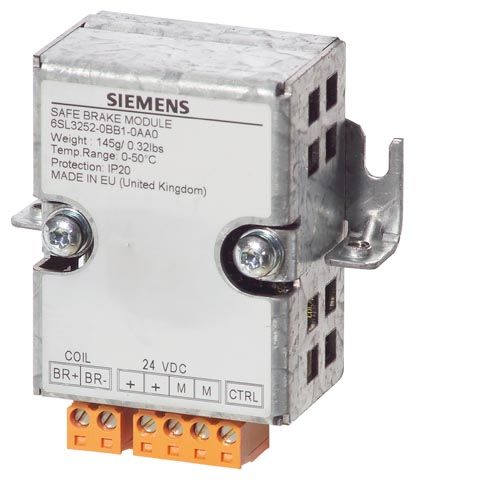
Safe Brake Relay
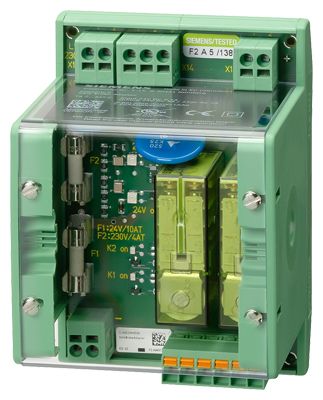
Safe Brake Adapter
Функции
Function
Control
Underlying function
Reaction to limit overshoot
External setpoint input effective
Encoder required 1)
License required
Basic Functions
STO
- EP terminals on the power unit or CUA31/CUA32 and a DI on the Control Unit
- F-DI on TM54F
- F-DI on CU310‑2
- PROFIsafe
SBC
(if activated)–
No
No
No
SBC
- With STO (immediately or following expiry of the delay time with SS1)
–
–
–
No
No
SS1
Time-driven
- EP terminals on the power unit or CUA31/CUA32 and a DI on the Control Unit
- F-DI on TM54F
- F-DI on CU310‑2
- PROFIsafe
STO following expiry of the parameterized delay time, SBC (if activated)
STO
Can be parameterized
No
No
Extended Functions
SS1 with SBR/SAM
- F-DI on TM54F
- F-DI on CU310‑2
- PROFIsafe
Safe Acceleration Monitor (SAM) or Safe Brake Ramp (SBR) during braking. STO and SBC (if activated) following expiry of the parameterized delay time or if the speed falls below the minimum speed limit
STO
Can be parameterized
No
Yes
SS2
- F-DI on TM54F
- F-DI on CU310‑2
- PROFIsafe
Safe Acceleration Monitor (SAM) during braking. Following expiry of the parameterized delay time SOS
SS1 → STO
No
Yes
Yes
SLS encoderless
- F-DI on TM54F
- F-DI on CU310‑2
- PROFIsafe
- Continuously activated
–
STO, SS1 (can be parameterized)
Yes
No
Yes
SLS
- F-DI on TM54F
- F-DI on CU310‑2
- PROFIsafe
- Continuously activated
–
STO, SS1, SS2 or SOS (can be parameterized)
Yes
Yes
Yes
SOS
- F-DI on TM54F
- F-DI on CU310‑2
- PROFIsafe
–
SS1 → STO
Yes
Yes
Yes
SSM
- Always active, if configured
–
Signals that the speed has fallen below a specified value (safe checkback signal switches to high)
Yes
No
Yes
SDI
- F-DI on TM54F
- F-DI on CU310‑2
- PROFIsafe
- Continuously activated
–
STO, SS1, SS2 or SOS (can be parameterized)
Yes
No
Yes
SLP
- F-DI on TM54F
- F-DI on CU310‑2
- PROFIsafe
–
STO, SS1, SS2 or SOS (can be parameterized)
Yes
Yes
Yes
SP
- Always active, if configured
–
–
Yes
Yes
Yes
SBT
- Safety Control Channel
- BICO signals
- for test stop selection
–
Signals test result. Warning if test failed
Yes
Yes
Yes
1) Encoderless Safety Extended Functions can be implemented only on request for SINAMICS S120 converters.