
- Каталог оборудования Siemens
- Каталог продуктов Siemens Industry
- Приводная техника
- Техника автоматизации
- Системы автоматизации
- Системы визуализации SIMATIC HMI
- Системы идентификации
- Промышленные коммуникации SIMATIC NET
- Промышленные аппараты управления SIRIUS
- Промышленные информационные технологии
- Управление на базе РС
- Системы управления процессом
- Контрольно-измерительные приборы
- Измерительные преобразователи для давления
- Приборы измерения температуры SITRANS T
- Расходомеры
- Уровнемеры
- Позиционеры
- Устройство для защиты и пуска двигателей SIMOCODE-DP
- Сигнализаторы сбоев в промышленном процессе
- Аппаратные ПИД-регуляторы SIPART
- Встраиваемые самописцы и индикаторы
- Технологии взвешивания
- Дополнительные компоненты
- Коммуникации и программное обеспечение
- Directives
- Анализаторы процесса
- Блоки питания SITOP
- Продукты для специальных требований
- Energy
- Автоматизация и безопасность зданий
- Низковольтная коммутационная техника
- Технология безопасности
- Системные решения и продукты для отраслей
- Сервис

Introduction
- Информационные материалы
Информационные материалы
SITRANS weighfeeders from Siemens can improve the accuracy of processing, blend consistencies, accountability, and record keeping. All weighfeeders come standard with a belt weigh bridge and speed sensor. An integrator is required to complete the system.
Область применения
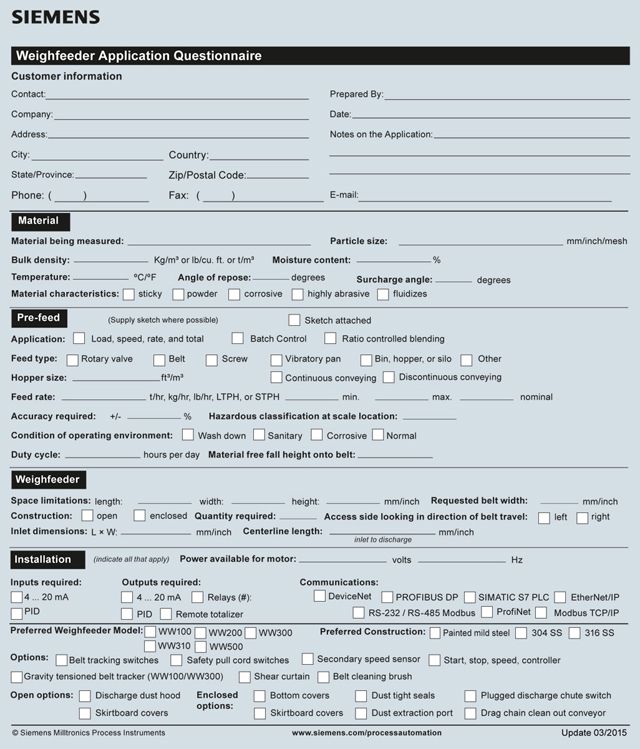
Weighfeeder Application Questionnaire
Способ действия
The weighfeeder is used to deliver an accurate mass flow rate of material. In the majority of applications, material is profiled by an adjustable mechanical shear gate, which fixes the correct material bed depth for a given particle size.
The feed rate is then maintained and adjusted by varying the speed of the belt. However, in some cases the belt speed is constant with rate control (if any) done by a pre-feeding device.
The system consists of three components: weight and speed sensing, integration and control, and the mechanical conveying system. Using the belt load and the belt speed signals, small incremental totals of weight per time are measured by the integrator and then the flow rate is calculated. The measured flowrate is compared against the desired flowrate and the on-board PID controller makes necessary corrections to the belt speed.
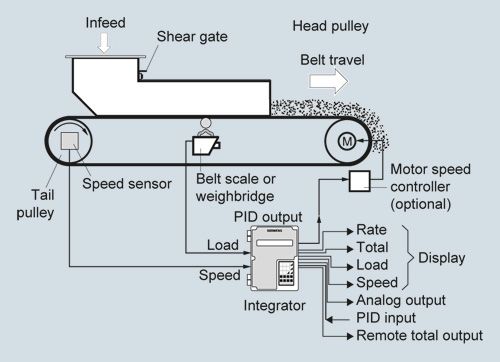
Weighfeeder operation
Design and Applications
SITRANS WW100
The platform weigh bridge mounts directly to a corrosion-resistant platform load cell. The direct load design eliminates all intermediate mechanical suspension and allows material weight to be directly applied to the load cell.
This design minimizes zero drift normally caused by intermediary suspension components and allows for the use of a very sensitive precision platform load cell. Load cell size and construction are chosen for each specific application.
SITRANS WW200
A stainless steel platform weighdeck with a Delrin slider bar assembly mounts directly to two corrosion-resistant, sealed platform load cells. The direct load design eliminates all intermediate mechanical suspension and allows material weight to be directly applied to the load cells. The frame of the WW200 is sturdy and rigid, ensuring stable and repeatable results, maximizing resolution and weighing accuracy.
SITRANS WW300
SITRANS WW300 suspends a single weigh idler on platform load cells. Its design eliminates all moving parts in the weighing
process and subsequent maintenance and replacement problems. There are no links or flexures. Two corrosion-resistant precision strain gauge load cells provide weight sensing signals to an integrator. This design feature minimizes zero drift and maximizes
resolution and weighing accuracy.SITRANS WW310
A modular design with external access to all bearings, speed sensors and load cells the WW310 is easy to maintain. Two corrosion resistant single point platform load cells mounted directly to a rugged idler ensure consistent weighing accuracy.
SITRANS WW500
This robust weighfeeder uses an endless series of overlapping pans mounted on heavy duty chains. The pans move on heavy duty rollers mounted on a rigid frame structure. The unique weigh system reduces dead load and applies live load directly to load cells for accurate measurement, without the use of check rods, pivots, or bearings. The four load cells are mounted below the apron pans to ensure protection and help with heat dissipation. Proven to enhance profitability by ensuring accuracy and accountability while reducing downtime.
Технические данные
Criteria
SITRANS
WW100SITRANS
WW200SITRANS
WW300SITRANS
WW310SITRANS
WW500Typical industries
Bulk chemicals, tobacco, food, water treatment
Bulk chemicals, tobacco, food, recycling
Cement, mineral processing, coal, mining, pulp and paper
Cement, mineral processing, coal, mining, pulp and paper
Cement, steel, power generation, and other heavy-duty industries
Typical applications
High-accuracy, low-capacity for minor ingredient additives
Low- to medium-capacity for minor ingredient additives
Medium- to high-capacity for macro ingredient additives
Medium- to high-capacity for macro ingredient additives
Medium-to high capacity for macro ingredient additives
Design rate range
45 kg/h ... 18 t/h
(100 lb/h ... 20 STPH)0.45 ... 100 t/h
(1 000 lb/h ... 110 STPH)4.5 ... 800 t/h
(5 ... 880 STPH)4.5 ... 270t/h
(5 ... 300 STPH)
10 ... 2 000 t/h (11 ... 2 200 STPH)
Belt speed
0.005 ... 0.36 m/s
(1 ... 70 fpm)0.005 ... 0.36 m/s
(1 ... 70 fpm)0.005 ... 0.36 m/s
(1 ... 70 fpm)0.005 ... 0.36 m/s (1 ... 70 fpm)
-
Pan speed
0.01 ... 0.25 m/s (2 ... 50 fpm)
Accuracy1)
± 0.25 ... 0.5 %
± 0.5 % or better
± 0.5 % or better
± 0.5 % or better
± 2 % or better
Specified range
10 ... 100 % based on speed
10 ... 100 % based on speed
10 ... 100 % based on speed
10 ... 100 % based on speed
33 ... 100 % based on speed
Sensing element
Long length platform weigh bridge
Single load cellPlatform weigh bridge
Dual load cellsSingle idler scale
Dual load cellsSingle idler scale Dual load cells
Pan supports on four load cells
Approvals
CE, RCM
Stainless steel options meet USDA and FDA requirements for food processingCE on all electrical components, hazardous approvals per configuration options
Stainless steel options meet USDA and FDA requirements for food processing
CE on all electrical components, hazardous approvals per configuration options
CE on all electrical components, hazardous approvals per configuration options
CE on all electrical components, hazardous approvals per configuration options
1) Accuracy subject to: On factory approved installations the weigh feeder system’s totalized weight will be within the specified accuracy when compared to a known weighed material test sample. The test rate must be within the specified range of the design capacity and held constant for the duration of the test. The minimum material test sample must be equivalent to a sample obtained at the test flow rate for three revolutions of the belt or at least ten minutes running time, whichever is greater.